
 Download als PDF File
Purpose
This note describes the conceptual structure of overlay/underlay, the available network topology models, VPN isolation, routing protocols, and CPE deployment modes in Huawei SD-WAN.
Overlay vs. Underlay
Underlay Network
The underlay network is the physical network infrastructure on which the overlay is built.
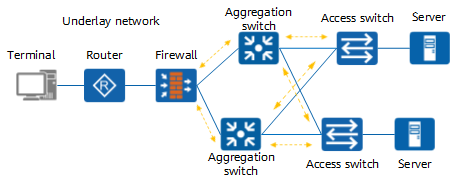
- Consists of physical devices: switches, routers, firewalls, load balancers
- Responsible for IP connectivity between sites (L2 or L3)
- Underlay routing protocols:
OSPF,IS-ISwithin an AS;BGPbetween ASes MPLS-based networks also belong to the underlay- WAN types in underlay:
MPLS,Internet,LTE/5G
Limitations of traditional underlay networks:
- Hardware-based forwarding strongly tied to transmission paths
- Configuration changes required when services change
- No security guarantee for Internet-based communication
- No on-demand network slicing
- Complex multi-path forwarding
Overlay Network
The overlay network is a logical network built on top of the underlay.
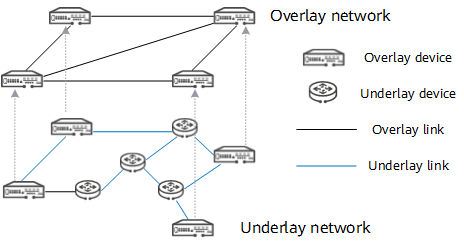
- Devices are connected via logical links, independent of the physical path
Tunnelsare established between overlay endpoints (e.g.,IPsecorGRE over IPsec)- The tunnel encapsulates the original IP packet with a new IP header + tunnel header
- The overlay network is transparent to the underlay
SD-WAN EVPN
EVPN (Ethernet VPN) is the core control-plane technology of the SD-WAN overlay.
- Extension of
BGPfor distributing MAC and IP routing information on the control plane (not the data plane) - Resolves the limitations of
DSVPN, which depended on VPN instances for tunnel establishment NHRPprotocol is no longer required- BGP peer relationships are based on endpoints, not links
- Edge sites only need to establish
IBGPpeer relationships with theirRRs — no full-mesh between all edges - Keys are distributed centrally (no per-tunnel
IKEnegotiation required) - Control node and data node are decoupled: routing policies control the topology
| EVPN advantage over DSVPN | Explanation |
|---|---|
| No NHRP dependency | Tunnel establishment via BGP signaling |
| No per-tunnel IKE negotiation | Keys centrally distributed by controller |
| Scalable | Edge sites only communicate with RRs |
| Flexible topologies | Hub-spoke, full-mesh, hybrid configurable via policy |
| Full Layer-2 reach | Cross-region L2 possible via EVPN MAC distribution |
Sites and the RR Concept
Site Types
| Type | Description |
|---|---|
Branch Site |
Branch office — CPE acts as edge gateway |
HQ Site |
Headquarters — often hub site |
DC Site |
Data center — often hub site |
Cloud Site |
Infrastructure on public cloud — vCPE (AR1000V / AR6700V-L) |
SD-WAN Site |
Site using SD-WAN technology, managed by iMaster NCE-Campus |

Arbeitet in Raum Basel (Switzerland) als Senior Network Engineer mit über 15 Jahren Erfahrung im Bereich Netzwerk