
 Download als PDF File
Purpose
This note explains the conceptual architecture of Huawei SD-WAN Solution, its layered structure, key components, acronyms, and typical deployment scenarios.
Background and Motivation
Enterprise WAN networks face four structural problems:
- Closed WAN architecture: Multi-cloud and multi-carrier connectivity is difficult with traditional networks.
- Poor application experience: Burst traffic displaces critical applications; the network is unaware of services.
- Slow service rollout: Traditional private lines require 1–3 months for provisioning.
- Difficult O&M: Manual CLI configuration on heterogeneous devices is error-prone and inefficient.
Huawei addresses these with the SD-WAN Solution built on iMaster NCE-Campus as the controller.
Architecture Layers
The Huawei SD-WAN architecture consists of three layers:
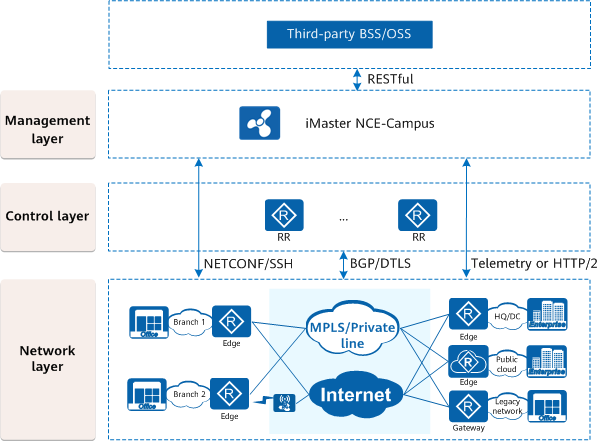
| Layer | Name | Core Component | Function |
|---|---|---|---|
| Top | Management Layer | iMaster NCE-Campus |
Service orchestration, O&M, northbound API |
| Middle | Control Layer | RR (Route Reflector) |
VPN route and topology distribution |
| Bottom | Network Layer | CPE (Customer Premises Equipment) |
Data forwarding, tunnel termination |
Management Layer
iMaster NCE-Campus is the central brain of the solution. Responsibilities:
- Abstraction of the SD-WAN network model, service orchestration, and automatic config delivery
- Collection of alarms, logs, and performance data
- Visualization of topology, alarms, and link quality
- Northbound API for integration into
BSS/OSSsystems of carriers or enterprises
Protocol notes:
- Devices running
V300upload performance data viaHTTP/2 - Devices running
V600upload performance data viaTelemetry - Controller-CPE connection uses
NETCONFover anSSHchannel - Reverse SSH tunnel enables controller → CPE O&M login
Control Layer
The RR is the core component of the control layer. Responsibilities:
- Distribution of
EVPNroutes between edge siteCPEs - Enforcement of topology models defined by the controller (
Hub-Spoke,Full-Mesh, etc.) - Control of route advertisement based on topology policy
Edge sites establish IBGP peer relationships with their assigned RR pair. Multiple RRs under one tenant are Full-Mesh on the control plane with each other.
Network Layer
CPEs are the edge devices at sites. Responsibilities:
- Build overlay tunnels (data plane)
- Terminate WAN links (
MPLS,Internet,LTE/5G) - Execute policies (
QoS,Traffic Steering,Firewall, etc.) - Plug-and-play / ZTP
Key Acronyms
| Term | Meaning |
|---|---|
CPE |
Customer Premises Equipment — edge router at a site |
RR |
Route Reflector — control-plane node for EVPN route distribution |
IWG |
Interworking Gateway — connects SD-WAN overlay to legacy MPLS networks |
POP |
Point of Presence — carrier-side entry point with POP gateway |
EVPN |
Ethernet VPN — BGP extension for MAC/route distribution on the control plane |
DSVPN |
Dynamic Smart VPN — older Huawei VPN technology, superseded by SD-WAN EVPN |

Arbeitet in Raum Basel (Switzerland) als Senior Network Engineer mit über 15 Jahren Erfahrung im Bereich Netzwerk