
 Download als PDF File
Purpose
This note summarizes the Huawei CPE device families used in the SD-WAN Solution, including their roles, characteristics, and typical use cases.
CPE Roles in SD-WAN
A CPE can take on different roles depending on configuration:
| Role | Function |
|---|---|
Edge Gateway |
Standard WAN connection point for a site |
RR (Route Reflector) |
Control-plane node; distributes EVPN routes in the overlay |
IWG (Interworking Gateway) |
Connects SD-WAN overlay to legacy MPLS networks |
POP Gateway |
Carrier-side entry point for cross-region reach |
Hub Site CPE |
Central node in the hub-spoke model (HQ, DC) |
Device Families at a Glance
| Family | Type | Positioning |
|---|---|---|
AR600 / AR6100 / AR6200 / AR6300 |
Physical Router | Small/mid branch to carrier-grade |
AR5700 / AR6700 / AR8000 |
Physical Router | Large/mid enterprise and high-performance sites |
AR1000V |
Virtual Router (VNF, x86/KVM) | Cloud deployment, vCPE, PoP, hub |
AR6700V-L |
Virtual Router (VNF, KVM/Public Cloud) | Cloud access gateway, IWG in cloud environments |
AR600 / AR6100 / AR6200 / AR6300 Series
Huawei NetEngine AR600, AR6100, AR6200, and AR6300 are next-generation physical routers.
Characteristics
-
Carrier-Class Reliability:- Hot swap of interface cards, SRU, power modules, fan modules, optical modules
- Redundant power supplies
- Dual SRU for redundancy (control, forwarding, switching plane)
- In-service patching (software upgrade without service interruption)
- Attack defense mechanisms
-
Powerful Service Integration:- Integrates routing, switching, wireless (voice, firewall, VPN, LTE/5G, WLAN) in one device
-
Multi-Layer Hardware Extensibility:- Industry-highest port density
- Flexible slot combinations (e.g., 2× SIC → 1× WSIC, 2× SIC + WSIC → XSIC)
- Supports LAN, WAN, and wireless connectivity from a single device
-
Remote Maintenance:- Plug-and-play, Zero Touch Provisioning, remote commissioning
- Centralized management via
iMaster NCE-Campus
Use Cases
Branch sites of all sizes, from small offices to larger branches with carrier-grade requirements.
AR5700 / AR6700 / AR8000 Series
Huawei NetEngine AR5700, AR6700, and AR8000 are next-generation physical routers for higher performance requirements.
Characteristics
-
Carrier-Class Reliability:- Hot swap of power modules and optical modules
- In-service patching
- Attack defense mechanisms
-
Powerful Service Integration:- Integration of routing, switching, and wireless
-
Multi-Layer Hardware Extensibility:- High port density, flexible slot combinations
-
Remote Maintenance:- Plug-and-play, ZTP, remote commissioning
- Centralized management via
iMaster NCE-Campus
Use Cases
Large enterprise branches, HQ sites, RR co-deployment, performance-intensive scenarios.
AR1000V
The AR1000V is a virtual router operating as a VNF (Virtual Network Function) on x86 hardware.
System Architecture
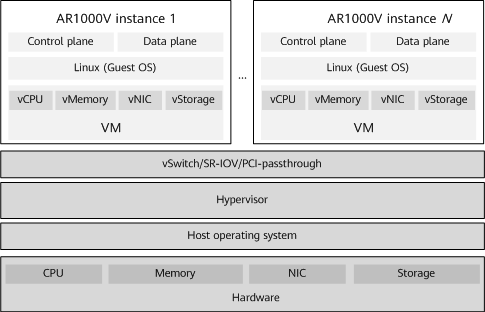
| Component | Function |
|---|---|
| Physical Hardware / Host OS | x86 hardware, CPU, memory, NIC, storage |
| Hypervisor | KVM or public cloud platform; isolates VMs from each other |
| vSwitch / PCI-passthrough | Data exchange between VMs and external networks |
| VM Instance | AR1000V VNF with dedicated vCPU, memory, storage, vNIC |
Supported Platforms
KVMon physical hardwareHuawei CloudAWSChina Telecom e-CloudAlibaba Cloud
Characteristics
- Based on Huawei’s
VRPplatform (same platform as physical NetEngine AR) - Decoupled control plane and forwarding plane
- Multi-core CPU with no forwarding bottleneck
- Fast and flexible deployment in
PoP, hub, or enterprise cloud environments - Automatic orchestration of overlay tunnels between sites
Use Cases
- Cloud access gateway (public cloud)
vCPEas hub site for global branchesPoPdeployment for carrier POP scenarios- SD-WAN extension into the public cloud segment
AR6700V-L
The AR6700V-L is a virtual router optimized for cloud and KVM environments. It is the newer complement to the AR1000V for cloud-native scenarios.
System Components
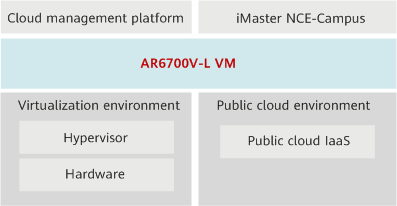
| Component | Function |
|---|---|
| Cloud Management Platform | GUI for virtual resources (e.g., OpenStack) |
iMaster NCE-Campus |
Central management and orchestration |
| AR6700V-L VNF | The actual virtual router |
| Physical Infrastructure | Underlying hardware (KVM/bare metal/public cloud) |
Strengths
- Based on Huawei’s leading network software platform (same as physical AR)
- Strong forwarding performance
- Deployable in
KVM,OpenStack, or public cloud Cloud Access Gatewayfunction: connects enterprise sites to public cloudIWGcapability: connects SD-WAN overlay to legacy networks in cloud environments- Unified security and management policies across cloud and physical networks
Networking Variants
| Variant | Description |
|---|---|
Single-Site Single-Gateway |
One AR6700V-L as gateway at a cloud site |
Single-Site Dual-Gateway |
Two AR6700V-L in active/standby or dual-active mode |
Dual-Site Networking |
DR-capable distribution across two sites |
Use Cases
- Cloud access gateway for enterprise branches with public cloud connectivity
IWGin virtualized or cloud environments- SD-WAN extension into KVM/OpenStack infrastructure
- Scenarios requiring unified security policies across cloud and on-premises
Comparison of the Four CPE Families
| Feature | AR600–6300 | AR5700–8000 | AR1000V | AR6700V-L |
|---|---|---|---|---|
| Type | Physical | Physical | Virtual (x86) | Virtual (KVM/Cloud) |
| Dual SRU | Yes | No | — | — |
| Public Cloud | No | No | Yes (AWS, HWC, etc.) | Yes (KVM/Cloud) |
| Primary Use Case | Branch to mid | Mid to large/HQ | Cloud vCPE, PoP | Cloud GW, IWG |
| License Activation | V300/V600 license file | V300/V600 license file | License file in controller | License file in controller |
Key Takeaways
AR600–6300= classic branch routers with carrier-grade redundancyAR5700–8000= higher-performance variant for HQ/DC and large sitesAR1000V= cloud VNF, runs on KVM or public clouds (AWS, Huawei Cloud, etc.)AR6700V-L= newer cloud VNF, optimized for KVM/OpenStack and cloud IWG scenarios- All four families: same VRP foundation, centrally managed by
iMaster NCE-Campus - All four families can function as
RR,IWG,Edge Gateway, orHub
Source
001_Docs/IMasterNCE/SDWAN/extracted/en-us_topic_0000001110534612.html(Introduction of CPEs)001_Docs/IMasterNCE/SDWAN/extracted/en-us_topic_0000001185861376.html(AR600–6300)001_Docs/IMasterNCE/SDWAN/extracted/en-us_topic_0000001231061015.html(AR5700–8000)001_Docs/IMasterNCE/SDWAN/extracted/en-us_topic_0000001163739043.html(AR1000V)001_Docs/IMasterNCE/SDWAN/extracted/en-us_topic_0000001526433262.html(AR6700V-L)
