
 Download als PDF File
Purpose
This note describes the multicast capability of Huawei SD-WAN, its functional principle, configuration concept, and constraints. The industry standard behind this feature is NGMVPN (Next Generation Multicast VPN) — Huawei refers to the SD-WAN implementation internally as „Multicast over SD-WAN“ using Replication Points.
Background: Unicast vs. Broadcast vs. Multicast
| Mode | Behavior | Problem |
|---|---|---|
Unicast |
Source sends a separate copy per receiver | Bandwidth consumption scales linearly with the number of receivers |
Broadcast |
Source sends to all hosts in the segment | Security risk, broadcast storms, no selectivity |
Multicast |
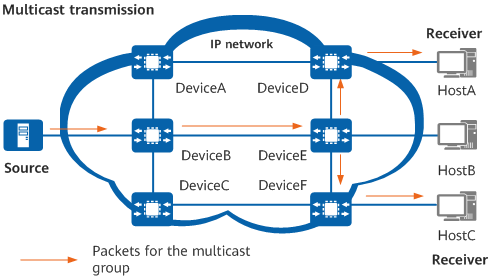
Source sends one copy; network replicates selectively to interested receivers | Bandwidth-efficient, selective, scalable |
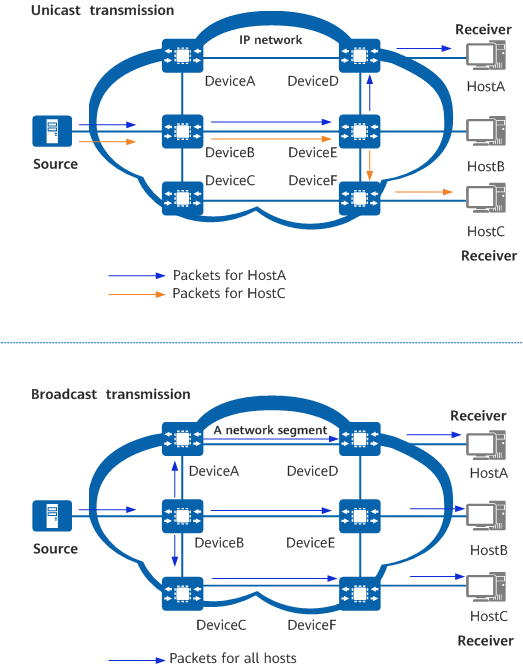
Multicast use cases:
- Multimedia / streaming media
- Online conferences and auctions
- Video on demand, distance learning
- Finance tickers (stock data)
- Shared operational data (e.g., IoT broadcasts)
NGMVPN and Huawei’s SD-WAN Implementation
NGMVPN (Next Generation Multicast VPN) is the industry term for multicast technologies built on MPLS/EVPN infrastructure that overcome the limitations of classical MVPN protocols (PIM, MSDP). Huawei implements multicast in SD-WAN via a proprietary model using Replication Points — conceptually equivalent to a simplified, controller-managed NGMVPN.
Core principle:
- Instead of PIM-based dynamic multicast routing,
Replication Pointsare statically configured iMaster NCE-Campusorchestrates the multicast topology- A
Replication Pointis a CPE that replicates multicast traffic and forwards it to downstream sites - Per multicast source: one primary and one secondary replication point (redundancy)
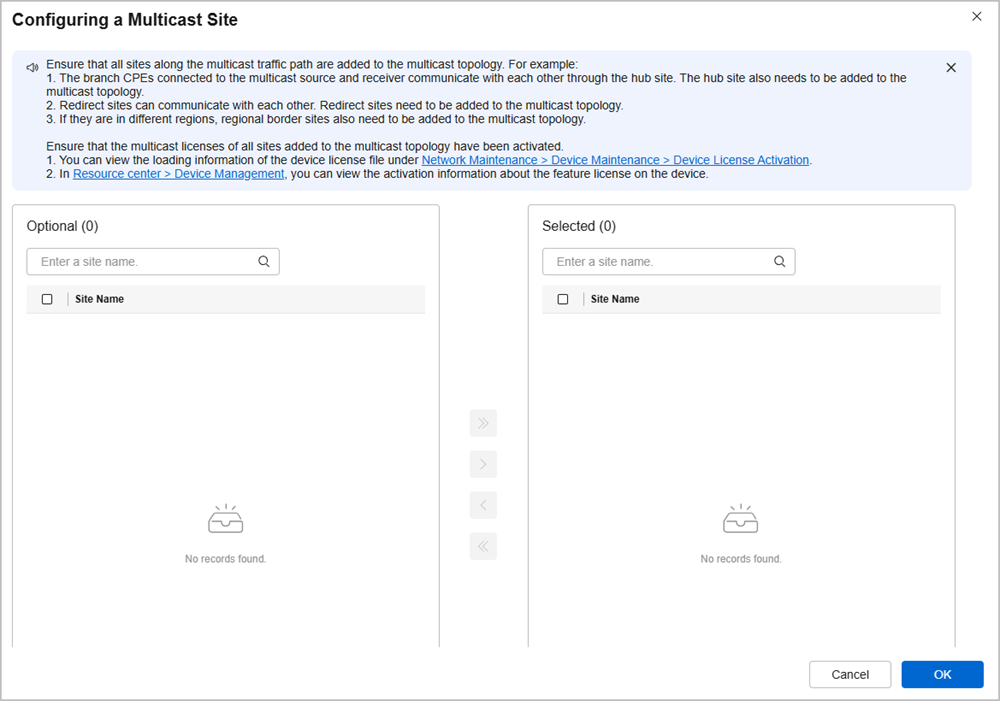
Multicast Topology in iMaster NCE-Campus
Configuration Steps (Overview)
- Enable multicast per VPN:
Network Configuration > SD-WAN > Overlay Network > Topology > Multicast Topology - Add sites to the multicast topology (all sites on the multicast traffic path)
- Create a
Copy Point Path(replication point path):- Define path name and multicast receiving site
- Define multicast source and primary/secondary replication sites
Which Sites Must Be Added to the Multicast Topology?
All sites on the multicast traffic path must be explicitly added:
| Scenario | Additionally required sites |
|---|---|
| Branch CPEs communicate via hub | Hub site must also be added |
| Source and receiver communicate via redirect site | Redirect site must also be added |
| Different regions involved | Regional border site must also be added |
License Requirement
Multicast licenses for the relevant sites must be activated before a site is added to the multicast topology:
- License load info:
Network Maintenance > Device Maintenance > Device License Activation
